This is the introduction of Attention Residuals (AttnRes), a drop-in replacement for standard residual connections in Transformers that enables each layer to selectively aggregate earlier representations via learned, input-dependent attention over depth.
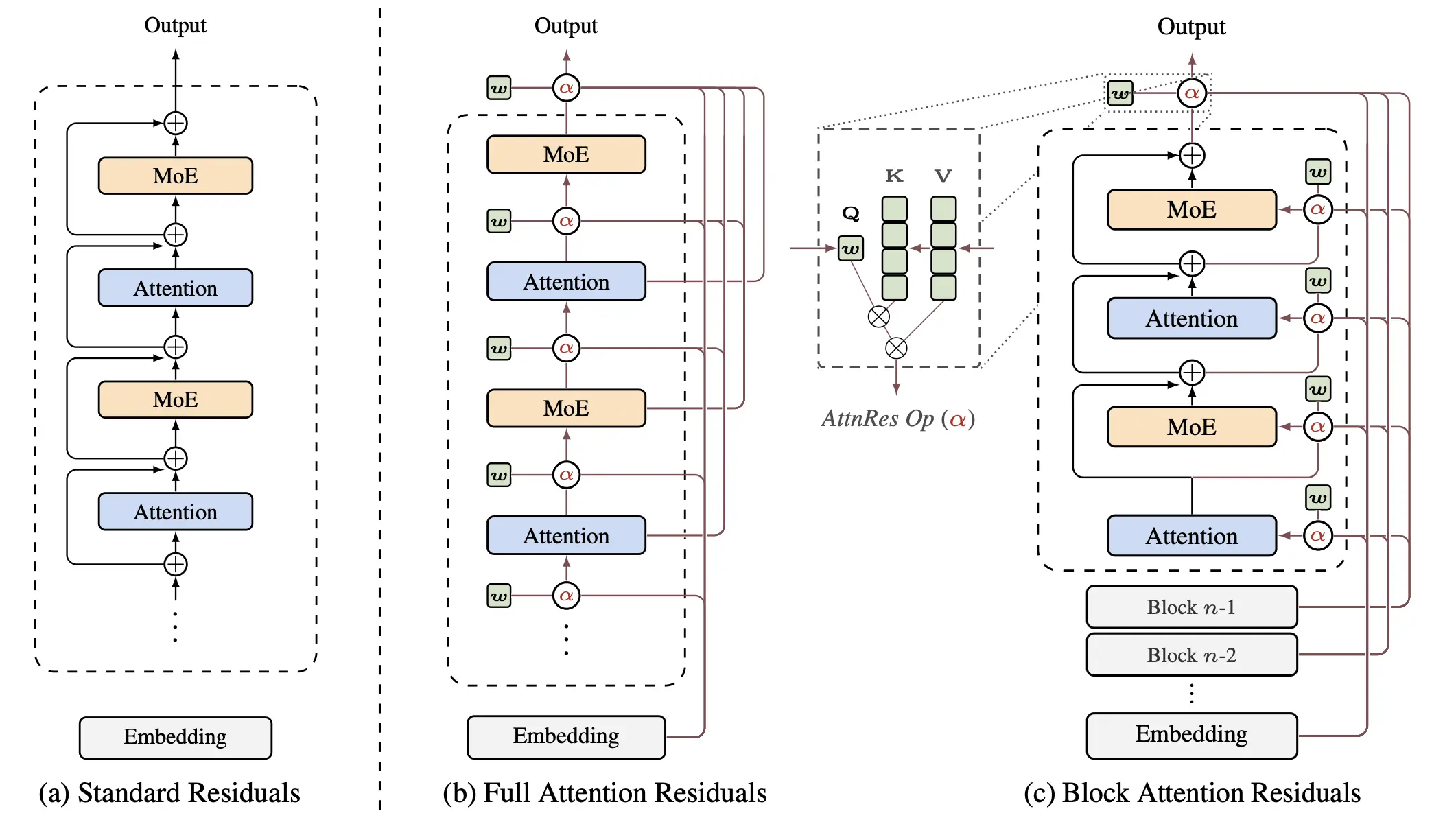
(a) Standard residuals with uniform additive accumulation. (b) Full AttnRes: each layer attends over all previous outputs. (c) Block AttnRes: layers are grouped into blocks, reducing memory from O(Ld) to O(Nd).
Overview
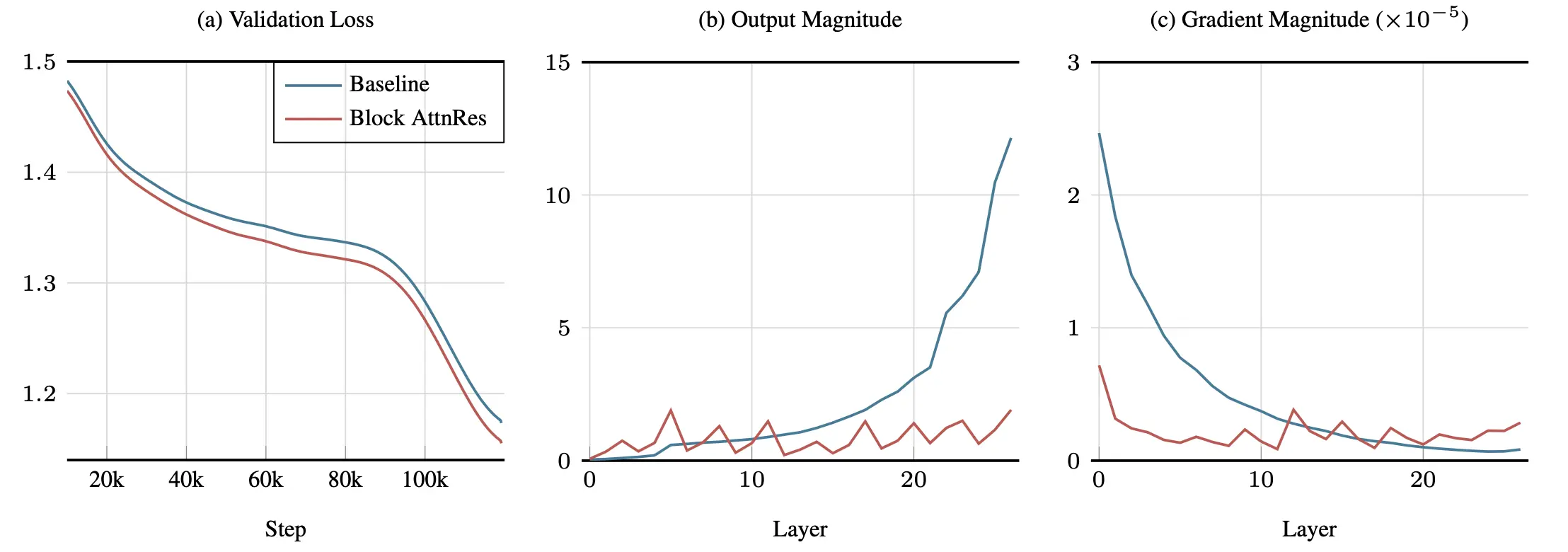
Standard residual connections accumulate all layer outputs with fixed unit weights. As depth grows, this uniform aggregation dilutes each layer’s contribution and causes hidden-state magnitudes to grow unboundedly — a well-known problem with PreNorm.
AttnRes replaces this fixed accumulation with softmax attention over preceding layer outputs:
$$\mathbf{h}_l = \sum_{i=0}^{l-1} \alpha_{i \to l} \cdot \mathbf{v}_i$$
where the weights $\alpha_{i \to l}$ are computed via a single learned pseudo-query $\mathbf{w}_l \in \mathbb{R}^d$ per layer. This gives every layer selective, content-aware access to all earlier representations.
Block AttnRes
Full AttnRes is straightforward but requires O(Ld) memory at scale. Block AttnRes partitions layers into N blocks, accumulates within each block via standard residuals, and applies attention only over block-level representations. With ~8 blocks, it recovers most of Full AttnRes’s gains while serving as a practical drop-in replacement with marginal overhead.
PyTorch-style pseudocode
def block_attn_res(blocks: list[Tensor], partial_block: Tensor, proj: Linear, norm: RMSNorm) -> Tensor:
    """
    Inter-block attention: attend over block reps + partial sum.
    blocks:
        N tensors of shape [B, T, D]: completed block representations for each previous block
    partial_block:
        [B, T, D]:    intra-block partial sum (b_n^i)
    """
    V = torch.stack(blocks + [partial_block])  # [N+1, B, T, D]
    K = norm(V)
    logits = torch.einsum('d, n b t d -> n b t', proj.weight.squeeze(), K)
    h = torch.einsum('n b t, n b t d -> b t d', logits.softmax(0), V)
    return h

def forward(self, blocks: list[Tensor], hidden_states: Tensor) -> tuple[list[Tensor], Tensor]:
    partial_block = hidden_states
    # apply block attnres before attn
    # blocks already include token embedding
    h = block_attn_res(blocks, partial_block, self.attn_res_proj, self.attn_res_norm)

    # if reaches block boundary, start new block
    # block_size counts ATTN + MLP; each transformer layer has 2
    if self.layer_number % (self.block_size // 2) == 0:
        blocks.append(partial_block)
        partial_block = None

    # self-attention layer
    attn_out = self.attn(self.attn_norm(h))
    partial_block = partial_block + attn_out if partial_block is not None else attn_out

    # apply block attnres before MLP
    h = block_attn_res(blocks, partial_block, self.mlp_res_proj, self.mlp_res_norm)

    # MLP layer
    mlp_out = self.mlp(self.mlp_norm(h))
    partial_block = partial_block + mlp_out

    return blocks, partial_block
Results
Scaling Laws
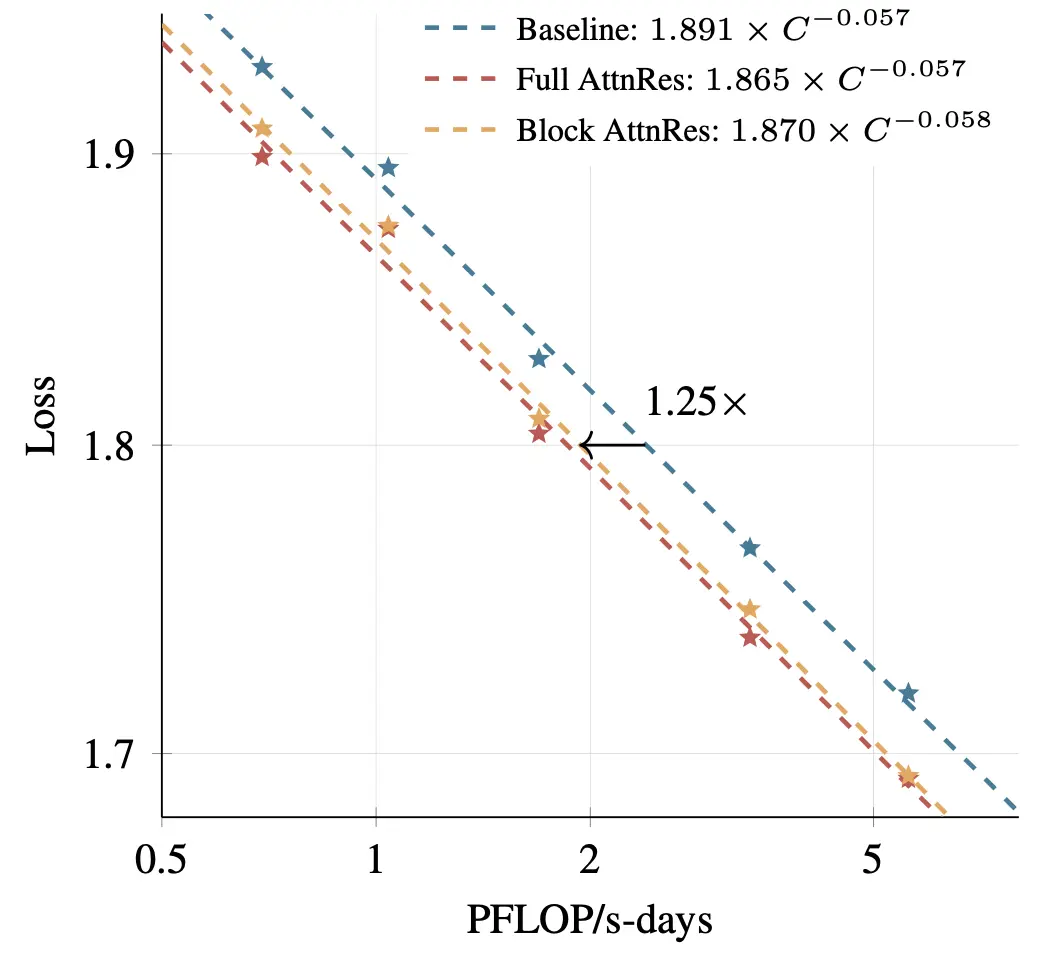
AttnRes consistently outperforms the baseline across all compute budgets. Block AttnRes matches the loss of a baseline trained with 1.25x more compute.
Downstream Performance (Kimi Linear 48B / 3B activated, 1.4T tokens)
| Category | Benchmark | Baseline | AttnRes |
|---|---|---|---|
| General | MMLU | 73.5 | 74.6 |
| GPQA-Diamond | 36.9 | 44.4 | |
| BBH | 76.3 | 78.0 | |
| TriviaQA | 69.9 | 71.8 | |
| Math & Code | Math | 53.5 | 57.1 |
| HumanEval | 59.1 | 62.2 | |
| MBPP | 72.0 | 73.9 | |
| Chinese | CMMLU | 82.0 | 82.9 |
| C-Eval | 79.6 | 82.5 |
AttnRes improves across the board, with the largest gains on multi-step reasoning (+7.5 on GPQA-Diamond) and code generation (+3.1 on HumanEval).
Training Dynamics
AttnRes mitigates PreNorm dilution: output magnitudes remain bounded across depth and gradient norms distribute more uniformly across layers.
Citation
If you found our work useful, please cite
@misc{chen2026attnres,
  title   = {Attention Residuals},
  author  = {Kimi Team  and Chen, Guangyu  and Zhang, Yu  and Su, Jianlin  and Xu, Weixin  and Pan, Siyuan  and Wang, Yaoyu  and Wang, Yucheng  and Chen, Guanduo  and Yin, Bohong  and Chen, Yutian  and Yan, Junjie  and Wei, Ming  and Zhang, Y.  and Meng, Fanqing  and Hong, Chao  and Xie, Xiaotong  and Liu, Shaowei  and Lu, Enzhe  and Tai, Yunpeng  and Chen, Yanru  and Men, Xin  and Guo, Haiqing  and Charles, Y.  and Lu, Haoyu  and Sui, Lin  and Zhu, Jinguo  and Zhou, Zaida  and He, Weiran  and Huang, Weixiao  and Xu, Xinran  and Wang, Yuzhi  and Lai, Guokun  and Du, Yulun  and Wu, Yuxin  and Yang, Zhilin  and Zhou, Xinyu},
  year    = {2026},
  archiveprefix = {arXiv},
  eprint        = {2603.15031},
  primaryclass  = {cs.CL}
}